Kindness & Gratitude
Lunchbox Notes for Kids: 40 Sweet, Silly & Brave Messages

A good lunchbox note is one or two lines your child can read in five seconds: specific, kind and free of pressure. Below are 40 original messages in four groups (silly, encouraging, kindness missions and brave), plus simple do's and don'ts, an age guide and the allergy and school-policy reminders worth a quick look before you tuck anything in. Copy them onto sticky notes, index cards or the back of an envelope. If you're planning ahead for the first day of the 2027 school year, you could write the first week's notes over one cozy evening.
Quick answer: what makes a lunchbox note work?
- Short beats long. One or two lines, big enough to read at a glance.
- Specific beats generic. "I loved watching you help your brother with his shoes" lands better than "Good job!"
- Never pressure. No grades, goals, or reminders about behavior.
- Ask older kids. Some want notes, some want a secret signal instead.
- Keep paper away from food, and follow your school's food rules.
What are the do's and don'ts of lunchbox notes?
The Child Mind Institute says praise works better when it names the exact behavior, such as sharing toys with a sibling, instead of a generic "Good job!" It also says that praising a child for being "smart" doesn't tell them which behavior was smart. That idea carries nicely into notes.
Do:
- Name one specific thing you noticed: a kindness, a bit of effort, a funny moment.
- Mention something to look forward to: "Pizza night is tonight."
- Rotate the format: a doodle one day, a riddle the next, a tiny mission after that.
- Keep the words at your child's reading level. For pre-readers, a picture and one word is perfect.
- Sign it the same way every time, with a little doodle that becomes your signature.
Don't:
- Bring performance into it: "Ace that spelling test!"
- Use it to correct: "Remember to share and be polite."
- Write anything you wouldn't want a classmate to read aloud. Nicknames, worries and baby names are better saved for home.
- Make it daily if it becomes a chore. A note you can keep up beats a streak that stresses you out.
With older kids, ask before you start. A dinner-table question works: "Do you want notes this year? Never, sometimes, or only on special days?" Then honor the answer, even if it's "never."
What are 40 lunchbox notes to copy?
All of these are original, so copy, tweak or mix them freely. Fill in [brackets] with your child's details.
Silly notes (1 to 10)
- "Official ruling: a sandwich is just a lunchtime hug with bread."
- "Today's forecast: sunny with a 100% chance of you."
- "Riddle: I hold your lunch but never get to eat it. What am I? (Answer: your lunchbox. It is very jealous.)"
- "Your silly mission today: make one friend laugh. Not the teacher. Probably."
- "Warning: this note contains one very big hug. Open carefully."
- "Dear banana, please stay unsquished today. Sincerely, a hopeful grown-up."
- "Today's secret handshake: tap your chest twice when you see me at pickup."
- "Knock, knock. Who's there? A very proud grown-up. A very proud grown-up who? Exactly."
- "If found, please return this kid to [home address]. Reward: big hugs and a snack."
- "I packed one extra smile in here. It's invisible. Use it whenever you need it."
Encouraging notes (11 to 20)
- "I'm proud of how you kept trying with [your bike] this weekend."
- "I noticed how kind you were to [your sister] yesterday. It felt good to see."
- "You don't have to be perfect today. You only have to be you."
- "Your questions make me think. Save one for dinner."
- "Whatever today holds, I'm glad you're mine, and I'll be there at pickup."
- "Something I love about you: you notice the little things."
- "New school year, same wonderful you."
- "Hard things get a little easier the second time. I believe in your second try."
- "You finished something tricky last week. Today you get to pick what's next."
- "You are loved at 8:00, at noon and at 3:00."
Kindness-mission notes (21 to 30)
Short missions turn lunch into a quiet adventure. They work well with older children if you keep the tone light. For more mission ideas, see our kindness activities for kids by age, and the free daily mission tool offers a tiny screen-free mission for 5 to 20 minutes.
- "Mission: say thank you to one grown-up at school today."
- "Mission: if you see someone standing alone, invite them in. Only if it feels right."
- "Mission: give someone a genuine compliment."
- "Mission: hold a door and count the smiles you get."
- "Mission: ask someone, 'What's the best part of your day so far?'"
- "Mission: offer to help someone carry something."
- "Mission: notice one kind thing someone else does, and tell me tonight."
- "Mission: say hello, by name, to someone you don't know well yet."
- "Mission: smile at a school helper, like the bus driver, the lunch staff or the librarian."
- "Mission: when you make a mistake today, say something kind to yourself."
Brave notes (31 to 40)
- "First days feel wobbly for everyone. Wobbly is okay."
- "Brave doesn't mean not scared. It means scared and doing it anyway, with a snack."
- "If your tummy flutters, take three slow breaths: smell the pizza, blow out the candle."
- "If today gets hard, find a helper: your teacher, the nurse or the counselor. That's brave too."
- "Pick one brave thing today: raise your hand, say hi, try a new game."
- "You've done new things before. Remember the first time you [rode the bus]?"
- "I'll be thinking of you at 10:00. That's when I'll cross my fingers."
- "Your classroom has a spot with your name on it. You belong there."
- "It's okay to miss home. It's okay to love school too. You can do both."
- "Tonight we'll swap rose, thorn and bud. Save yours for me."
Note 40 pairs with the check-in routine in our back-to-school feelings check-in. If your child had a memory-book summer, the summer memory book makes a great reference for a note like number 36.
How do I adjust notes by age?
| Age | Format | Example |
|---|---|---|
| 4-6 | A picture and one word; a sticker | A heart and a sandwich with the word "hug" |
| 7-9 | One-liners, riddles and tiny missions | Notes 3, 4 and 21 |
| 10+ | Tiny, private and occasional; inside jokes; ask first | A sticky note with a code word only the two of you know |
For younger children, a note they can't read yet still works if the picture does. Draw the same small symbol each time, like a star or a sun, so it becomes "their" sign.
What about allergy and school-policy reminders?
Paper notes themselves don't contain food, which makes them an easy way to say "I love you" in a lunchbox. Still, a few common-sense guardrails are worth a glance:
- Skip attached treats. KidsHealth advises families of children with food allergies to send their child's lunch and snacks from home and to ask the school to discourage food sharing among all children. A note that comes with candy or a snack can undercut that rule.
- Check your school's policy. The CDC published voluntary national guidelines for managing food allergies in schools in October 2013, according to FARE, but your own school or district sets the rules that apply to you. If you're unsure whether something is allowed, ask the teacher or school nurse.
- Keep the note out of the food. Put it on top of a closed container, in a lid pocket or in a zip bag so it stays dry and doesn't touch anything your child will eat.
- Skip glitter and loose stickers around food, since bits can flake off into it.
- Think about the classroom. If lunch is eaten with friends, a note can be read over a shoulder. Keep anything private for home.
Sticky notes, index cards or greeting cards?
| Option | Good for | Watch out for |
|---|---|---|
| Sticky note | Fast, cheap, easy to hide under a napkin | Peels off and gets lost |
| Index card | Sturdy; room for a doodle | Can look plain |
| Blank greeting card | First-day, big-day and keepsake notes | Bigger than a typical note; measure your lunchbox |
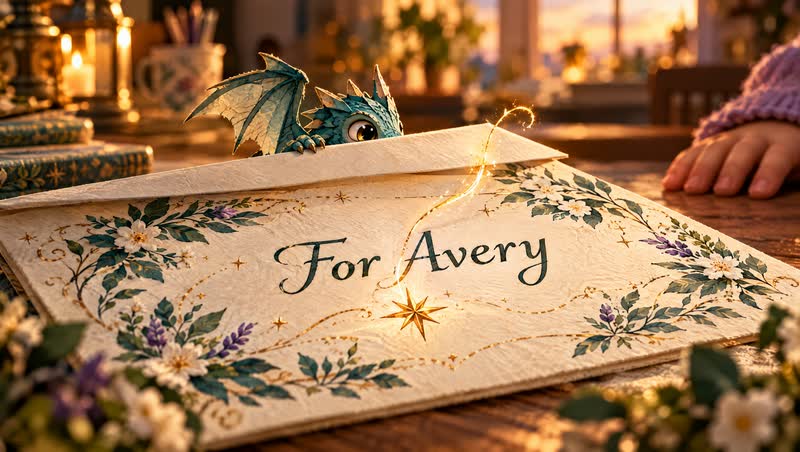
The Magical Moments greeting cards are blank, watercolor-style cards that measure about 4 by 5.6 inches and come in six designs: Enchanted Castle, Unicorn's Meadow, Moonlight Dragon, Fairy Garden, Mermaid's Grotto and Winter Wonderland. Because they're larger than an index card, check your lunchbox before you count on one fitting. They can also ride in a backpack pocket or a folder, or wait on a pillow for the end of a hard day. You can see all six designs together in the greeting cards collection.
How do I make notes a habit?
- Batch them. On Sunday, write five notes and stack them in a jar or a drawer.
- Let your child contribute. A jar of their own ideas means the notes feel like theirs. Ask them to slip a note back into your bag, too.
- Pair it with a check-in. A note is a tiny start to a longer chat at pickup, and the prompts in the back-to-school check-in are a good fit.
- Save the best ones. A shoebox of favorite notes is a keepsake in its own right, and a lovely thing to open at the end of the school year.
Make it magical with Wonderkin
The blank Magical Moments cards come in six watercolor designs and have room for a longer note, a thank-you or a first-day message. Browse the greeting cards collection when you want one. Wonderkin Adventures is a small shop run by a working mom and veterinarian who loves her daughter.
Questions parents ask
What should I write in a lunchbox note?
Keep it to one or two lines and make it specific: name something your child did, a kind thing you noticed, or something to look forward to. The Child Mind Institute notes that naming the exact behavior works better than a generic 'good job.' Skip test scores and reminders.
Should I put a note in my older child's lunch?
Ask first. Some older kids love a note, while others would rather skip it in front of friends. Offer options: a tiny note folded small, an inside joke, a note only on big days, or no note at all. Let your child say no without guilt.
How often should I write lunchbox notes?
As often as feels easy. Once a week, every Monday, or only on big days like the first day, a test or a tough week all work. A note you can keep up is better than a daily one that turns into a chore for you or pressure for your child.
Are lunchbox notes okay for kids with food allergies?
Paper notes are fine, but keep them away from food. KidsHealth advises families of children with food allergies to send lunch from home and ask schools to discourage food sharing, so skip notes that attach candy or treats, and follow your school's own rules.
What if my child asks me to stop writing notes?
Say thank you and stop, or swap the note for something private: a secret handshake, a word you whisper at drop-off, or a sticky note on the bedroom mirror. Respecting the request tells your child their feelings count, and you can bring notes back for a special day.