Advent
Do You Have to Be Christian to Do an Advent Calendar?

Quick answer: No. Advent itself is a Christian season of preparation before Christmas, but a countdown calendar is something any family can enjoy, whatever you believe or celebrate. The respectful way to do it is to be honest about what you're doing: call it a countdown or winter calendar, learn what Advent means, and choose the version that fits your family. This is a short, general overview, not religious instruction. For how your own tradition observes a holiday, your faith community is the best guide.
Key takeaways
- Advent is a Christian season observed on the four Sundays before Christmas. In 2026 it runs November 29 to December 24; in 2027 it begins November 28.
- Advent calendars began in Christian homes. Today many are simply countdowns to a December date, with no religious content.
- There are four easy options: a secular countdown, a tradition-rooted countdown, an interfaith countdown or a winter-season countdown.
- Be honest and curious. Name it plainly, learn the meaning and give other holidays their own space.
What is Advent, exactly?
The word comes from the Latin adventus, meaning "coming" or "arrival." According to the U.S. Conference of Catholic Bishops, Advent is the season of the four Sundays and weekdays leading up to Christmas. It opens the Catholic Church's liturgical year and is a time of preparation. Anglican, Lutheran and many other Christian churches observe Advent too. Because Christmas falls on a different weekday each year, the first Sunday moves: it is November 29 in 2026, and by the same rule November 28 in 2027.
The roots go back a long way. History Hit traces Advent to the 4th and 5th centuries, when believers in what is now France, Spain and northern Italy kept a period of fasting, prayer and reflection before Christmas. Eastern Orthodox Christians keep a related season, the Nativity Fast, which the Orthodox Church in America says begins on November 15 and is also known as "Advent." Calendar practice varies between churches, so dates can differ.
How did Advent calendars become a December countdown for everyone?
According to History Hit, the first Advent calendars are thought to date to German Lutheran homes in the mid-19th century, when families marked the days of December with chalk marks on a door or cupboard. In the early 1900s a Munich printer named Gerhard Lang is usually credited with the first printed calendars (sources differ on the exact year, and History Hit gives 1908). Little doors came later, and production resumed after World War II.
From there, calendars spread through Europe and America. Today they come in dozens of themes, and many are simply a way to count down to a December celebration rather than a religious practice. That history is why one calendar can mean two different things in two different homes.
Advent vs. a countdown calendar: what is the difference?
| Advent (religious season) | Countdown calendar (secular) | |
|---|---|---|
| What it is | A Christian season of preparation before Christmas | A daily ritual that builds anticipation toward a date |
| When | The four Sundays before December 25 (Nov. 29 to Dec. 24 in 2026) | Any run of days, often December 1 to 24 |
| What's inside | Prayers, readings, candles or wreaths, depending on the tradition | Treats, activities, stories or kindness missions |
| Who it's for | Christians observing the season | Any family that likes a daily ritual |
What are four respectful ways to do an advent calendar, whatever you celebrate?
1. A secular countdown (adventure, learning or kindness)
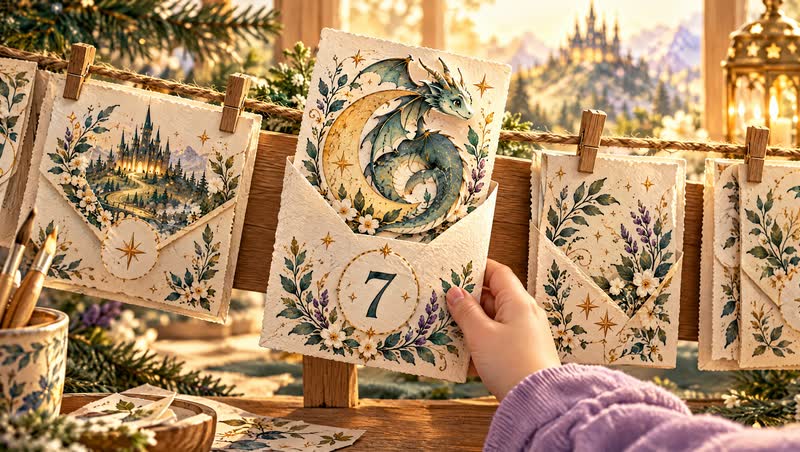
This is the simplest option. You count down to winter break or a family day, and the calendar holds missions rather than religious content: geography, kindness, nature and family games. Call it "our December countdown" and fill it with things your family loves. Our ideas for non-chocolate calendar fillers, kindness countdowns and calendars for kids of different ages are a good place to start.
2. A tradition-rooted countdown (built from your own holiday)
If your family celebrates Hanukkah or Kwanzaa, those holidays already have their own shape, and you may not need a 24-day calendar at all. According to Hebcal, Hanukkah 2026 begins at sundown on Friday, December 4 and ends on Saturday, December 12, and Hanukkah 2027 begins at sundown on Friday, December 24. NBC New York describes Kwanzaa as a seven-day holiday celebrated from December 26 to January 1 and created by Maulana Karenga in 1966, and Encyclopedia.com notes it is not meant to replace other year-end holidays.
A countdown can be as simple as learning one thing a day about your holiday's story, foods and music. For anything religious, follow your own community's guidance.
3. An interfaith or multi-tradition countdown
Some families celebrate more than one holiday, or have neighbors and relatives who do. Give each its own space instead of folding one into another. Hanukkah has its own story, for example, and shouldn't be treated as a stop on the Christmas calendar. Dedicate a few days to learning how a friend's family celebrates, or read about Christmas traditions around the world to see how many ways there are to mark the season.
4. A winter-season countdown
Count down to the solstice, the shortest day of the year in the Northern Hemisphere. Star Walk lists the December solstice as December 21, 2026, at 3:50 p.m. EST, and December 21, 2027, at 9:43 p.m. EST. Fill the days with lanterns, stars, winter animals, baking and nature walks. It's a calendar tied to the sky, which every family shares.
How do the four options compare?
| Option | Best for | A first-day idea | Keep in mind |
|---|---|---|---|
| Secular countdown | A daily ritual with no religious content | Find a country on a map | Name it honestly as a countdown |
| Tradition-rooted | Families whose holiday has its own customs | Learn the story behind your holiday | Follow your own community's guidance |
| Interfaith | Households that celebrate more than one holiday | Read about a neighbor's tradition | Give each holiday its own space |
| Winter-season | A nature-based theme | Note today's sunrise and sunset | December is summer in the Southern Hemisphere |
How do you choose the one that fits your family?
Ask yourself three questions:
- What does our family celebrate, and does it have customs we want to honor?
- Who else lives in or visits our home, and how do they celebrate?
- What do we want the countdown to do: build excitement, teach something or make time for each other?
If the answers point in different directions, start with the simplest option, a secular countdown, and add a day or two for each tradition in your circle.
A sample week of a secular countdown
| Day | Mission | What it builds |
|---|---|---|
| 1 | Find a country on a map and learn how to say hello | Geography |
| 2 | Write a thank-you note to someone who helps your family | Kindness |
| 3 | Cook a family recipe together | Family time |
| 4 | Watch the sunset and note the time | Nature |
| 5 | Read a winter story from another culture | Curiosity |
| 6 | Make paper stars or lanterns | Craft |
| 7 | Play a favorite family game | Togetherness |
How do you borrow a tradition respectfully?
- Name it honestly. If it's a countdown, call it a countdown.
- Learn the meaning before you borrow the form. Spend five minutes reading about Advent from a reliable source.
- Treat religious symbols with care. Candles, wreaths and prayers mean something to the people who use them, so use them only with understanding.
- Give other holidays their own space. Don't fold them into someone else's calendar.
- Stay curious with kids. "Some families do this. Our family does that" is a complete, respectful answer.
Is it disrespectful to use an advent calendar if you're not Christian?
Not inherently. Respect comes from how and why you do it, not from what you believe. Individual families, including Christian families, may feel differently about store-bought countdowns, so lead with courtesy. A helpful test: could you kindly explain what you're doing to a neighbor who observes Advent? If so, you're on solid ground.
What do you say when your child asks, "Why do my friends have an Advent calendar?"
Keep it short, warm and true. Try: "Some families celebrate Christmas, and Advent is the season Christians use to get ready for it. Our family does something different, and we have a countdown calendar because we love doing something fun together every day." If your child is curious, read a book about a friend's tradition together or invite your child to ask their friend to explain it.
Is it too late to start now?
Not at all. Advent 2026 begins on November 29, and most countdown calendars begin on December 1, so you have time to gather 24 simple missions, choose a container and set up a spot where your child can find each day's surprise. If you're reading this later in the season, a countdown can start on any day.
Where does Wonderkin fit?
Wonderkin's Around the World Advent Calendar Passport is adventure- and learning-led: 23 countries across six regions, one clue and mission a day, with Day 24 a "Home for Christmas" finale. You supply your own 24-compartment calendar. The printed passport and 24 stickers are mailed to you, and the parent guide and clue cards are printable. Check the Etsy listing for the current price. It's sold as a Christmas countdown, so families who don't celebrate Christmas may want to swap the last day for a family tradition of their own. The daily geography missions work whatever the holiday.
Want to learn more first? See what an advent passport is and our guide to choosing a kids' advent calendar. If you're planning ahead, our Advent 2027 dates and timeline has the details, and if you're starting late, see how to start an advent calendar late. For the broader picture, our Christmas countdown activities show other ways to count down.
Make it magical with Wonderkin
Whatever you celebrate, a daily ritual can turn the countdown to winter into time together. Our advent calendar passports are adventure- and learning-led, with a new mission every day. Wonderkin Adventures is a small shop run by a working mom and veterinarian who loves her daughter.
Questions parents ask
Do you have to be Christian to do an Advent calendar?
No. Advent itself is a Christian season of preparation before Christmas, but a countdown calendar is a daily ritual any family can enjoy. If your family is not Christian, it helps to call it a countdown or winter calendar, learn what Advent means, and fill it with activities that fit your own values.
What is the difference between Advent and an Advent calendar?
Advent is a Christian season observed on the four Sundays before Christmas, with its own prayers, readings and customs. An Advent calendar is a daily countdown that began in Christian homes and is now often a secular countdown to a December holiday, filled with treats, activities or stories instead of religious content.
Can families who celebrate Hanukkah or Kwanzaa use a countdown calendar?
Yes, if they want to. Hanukkah and Kwanzaa have their own dates and customs, so families may prefer to build a countdown around those instead, or skip a 24-day calendar entirely. A neutral winter countdown can sit alongside any holiday. For questions of practice, your own community is the best guide.
When does Advent start in 2026 and 2027?
Advent begins on the Sunday closest to November 30. The U.S. Conference of Catholic Bishops lists Advent 2026 as November 29 through December 24. By the same rule, Advent 2027 begins on Sunday, November 28. Countdown calendars commonly start on December 1, which is a separate custom.
What should I call a calendar that is not religious?
Call it what it is: a December countdown, a winter countdown or an adventure calendar. Naming it honestly respects families who observe Advent as a religious season, and it gives your own children clear words for what your family is doing and why.