Advent
One Advent Calendar for Kids of Different Ages

The easiest advent calendar for multiple kids of different ages is one shared mission each day, written at two or three levels. Everyone opens the same door at the same moment, but the toddler, the second grader, and the almost-teen each get a version that fits. Nobody gets a "baby" job, and nobody gets an impossible one. If you are still choosing what goes behind the doors, begin with our guide to Christmas countdown activities for kids, then come back here to make it work for a mixed-age house.
Quick answer: how to share one advent calendar
- Pick a model. Tiered missions, take-turns days, or older-child-leads days (all below).
- Write each mission at two or three levels. Same activity, different jobs.
- Rotate the roles. Opener, reader, sticker-placer, helper.
- Keep every day to 5 to 15 minutes. A calendar you can keep up with beats a grand one you abandon.
Which of the three models fits your family?
| Model | How it works | Best when | Watch out for |
|---|---|---|---|
| Tiered missions | Same mission each day, written at two or three levels | Ages are three or more years apart | You write more than one version |
| Take-turns days | Each child "owns" certain days and picks or leads the mission | Kids are close in age, or competitive | Arguments about whose day is better |
| Older-child-leads | The oldest plans or reads the day and assigns jobs | A tween wants status and responsibility | Turning the tween into a babysitter |
You can also mix them: tiered missions on most days, take-turns for the days that spark arguments, and older-child-leads on a few special ones. Start with whichever model removes your biggest nightly friction.
What do six sample days look like at three age levels?
Here is one mission per row, adapted three ways. Every one needs only household supplies and about ten minutes.
| Day type | Toddler (2 to 4) | School-age (5 to 8) | Tween (9 to 12) |
|---|---|---|---|
| Around the world | Spin a globe and point to the blue and the green | Find a country on a map and say hello in its language | Look up one holiday tradition there and teach it to everyone |
| Kind act | Draw a picture for a neighbor | Write the note to go with it | Plan a small act and deliver it with a grown-up |
| Story hour | Name the pictures in a board book | Read a picture book aloud to the group | Invent a "what happens next" ending |
| Move | Hop like a reindeer | Run a pillow obstacle course | Design the course and time everyone |
| Make | Crayons and large stickers | Paper snowflakes with kid-safe scissors | Design gift tags for the family |
| Animals | Make the animal sounds game | Find an animal's habitat on a map | Look up how one animal handles winter |
A few cautions. The Consumer Product Safety Commission advises keeping small balls and toys with small parts away from children younger than 3, so skip tiny trinkets for the youngest. Supervise scissors and glue at every age.
How do I choose missions that stretch across ages?
Look for missions with three built-in entry points: something to look at or touch, something to say or read, and something to make or decide. A map day is a good example. A toddler can point, a school-age child can read the country's name aloud, and a tween can find out what the people there eat for the holidays.
Choose open-ended prompts ("draw what you think lives there") so there is no wrong answer to compare, and avoid anything with a winner. Keep a short list of swap-in options for rough days, such as a story, a song, or a cocoa break, so a bad night never becomes a skipped door.
If you tuck a small treat or trinket behind each door, aim for equal in size rather than equal in cost, and keep the small-parts caution above in mind for the youngest child's items.
What does a 10-minute day look like?
A simple rhythm keeps three ages in one room:
- Gather (1 minute). Everyone sits near the calendar, and the day's opener opens the door.
- Reveal (2 minutes). The day's reader shares the mission.
- Do (5 to 8 minutes). Each child works at their own level.
- Close (1 minute). Add a sticker or tick, and each person names a favorite part.
Spend ten minutes on Sunday looking at the week ahead, gathering supplies, and writing each level on a sticky note. That small habit does most of the work.
What if the ages are...?
A toddler and a school-age child. Make the older child the reader and the toddler the "finder." Keep the toddler's version under two minutes so the older child is not left waiting.
A school-age child and a tween. Give the tween Level Up choices and the final say on one day each week. Keep scoring and "who did it best" out of it.
Three or more kids. Let each child own a day of the week, with one "everybody" day. Everyone helps on every day; the owner just gets to choose.
What fairness rules stop the "that's babyish" argument?
- Same door, same moment. Nobody opens ahead or behind.
- Real jobs at every level. A toddler's job is small but genuine, and a tween's job has real authority.
- Rotate the roles. Opener, reader, sticker-placer, timer. Swap daily.
- Level Up, not Level Down. The tween can pick the harder option; nobody is told they are getting the easy one.
- No scoring across siblings. The mission is the team's, not a contest.
- Allow a pass. A cranky child can watch and still hear the story.
Can each sibling have their own passport?
That depends on your energy. Each Wonderkin advent passport is a printed booklet with 24 numbered stickers that is mailed to you, plus a parent guide and clue cards as PDFs you print (some kits add a map or trails). As described in the listings, each kit includes one printed passport, so separate passports means separate kits (check the current listing). The Around the World Advent Calendar Passport visits 23 countries, with a "Home for Christmas" finale on Day 24, and each day is a guess-the-country clue card plus a 10 to 20 minute mission. The Wildlife Explorer Passport trades countries for animals, with missions of about 5 to 25 minutes. A Magical Creature version is also available.
The listings do not state recommended ages, and the Around the World listing does not list a personalization option, so you would be the one adapting the missions, which is exactly what the levels above are for. Giving siblings different themes can work, but it doubles your nightly prep. One shared passport plus levels is the lower-prep route: everyone takes a turn adding the day's sticker.
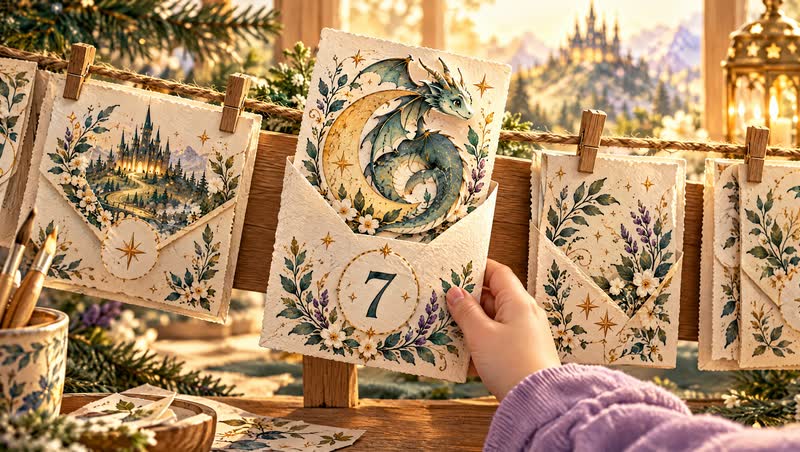
Remember, the kits do not include a calendar. You provide the 24 doors, or use envelopes, pockets, or numbered bags. For a deeper look at the format, see what is an advent passport.
What about the start date?
Advent calendars vary: many reusable ones begin on December 1, while others follow the church calendar and start on the first Sunday of Advent, which falls on November 29 in 2026. Most run through Christmas Eve or Christmas Day. So there is no single right day to begin. If you are behind, our late-start advent plan has options, and the non-chocolate advent ideas and around-the-world Christmas traditions are full of mission ideas. For a kindness-themed version, see kindness advent calendar ideas.
Make it magical with Wonderkin
Wonderkin's three advent passports (Around the World, Wildlife Explorer, and Magical Creature) pair a printed passport and stickers, mailed to you, with a digital parent guide and clue cards you print at home. You bring the 24-door calendar. Check each listing for what ships and when. Browse the Advent Calendar collection or start with the Magical Creature Advent Passport.
Questions parents ask
Can one advent calendar work for toddlers and older kids?
Yes. Pick one shared mission each day and give it two or three levels. A toddler can point, stamp, or help with the physical part, a school-age child can read and decide, and a tween can lead or invent the next step. Everyone opens the same door together, so nobody is left out.
How do I stop an older child from saying the calendar is babyish?
Give the older child real responsibility instead of a smaller version of the same task. Let them lead the day, write the next clue, or choose the mission, and offer an optional Level Up on some days. Being trusted with a real job can feel better than being handed an easy one.
How long should each advent day take with siblings?
Five to fifteen minutes is plenty. With mixed ages, the shorter end keeps the youngest engaged and keeps the oldest from feeling it drags. On busy days, choose the mission with the least prep and make the Level Up optional. A calendar you can keep up with beats an ambitious one you abandon midway.
Do the Wonderkin advent passports come with a calendar?
No. Each passport is a printed booklet with stickers that is mailed to you, plus a digital parent guide and clue cards you print yourself. You supply your own 24-compartment advent calendar, or use 24 envelopes or pockets. Check the listing for the current delivery estimate before you plan around a start date.
When does Advent start in 2026?
The first Sunday of Advent in 2026 is November 29, and Advent runs until Christmas Eve. Many reusable calendars simply begin on December 1 instead, so there is no single right start date. Choose the one that fits your family's days.
Is it safe to put small trinkets in a calendar for a toddler?
Keep anything with small parts away from children younger than 3, as the Consumer Product Safety Commission advises for toys and small balls. For toddlers, choose experiences, big board books, or chunky items instead of tiny trinkets, and always supervise scissors, glue, and craft supplies.